Volkswagen Transporter T5
Road Test: 2008, Crewvan, Tiptronic, TDI, 128 kw/400nm
The Volkswagen Transporter T5 Crewvan: a large, versatile, van that comes in
a big range of specifications.
This
is my new van and as I had great difficulty in finding any independent information
on the internet I decided to post this report, which may assist other purchasers.
I took delivery in January 08 and have kept this report up to date. The
van was sold in August 2010, and I will never buy another VW.
.
This article is written by Jeff Lacey the owner of the the Transporter for the
duration of the report. All opinions expressed are those of Jeff Lacey and have
not been influenced by a third party. The report was written when the van was
new and updated over the ownership period.
Easels
Galore Index Falcon 50th Anniversary Turbo Ute
MY11Subaru Liberty
I make easels and in 2007 wanted a new work vehicle. It had to be a van, powerful,
automatic with plenty of creature comforts. Something I could jump into and
deliver a load of the easels, to Sydney, or even Brisbane, without my 58 plus-year-old
body (in 2007) dying of aches and pains in the process.
It is the first car I have
owned that feels bullet proof, well almost. I know I have state of the art safety
around me combined with excellent vision, high driving position and surprisingly
good handling. The thing that really swings me is it harks back to the real
cars of the 60,s with all the modern features. It actually is fun to drive,
you are not totally cosseted and insulated in a capsule remote from the world
that you have difficulty seeing out of. You hear the engine, you feel the suspension,
and you can see out of it.!!! No tiny side windows, no small windscreen. Power,
that flows when you press the accelerator. The motor really growls and hauls,
in a dieselly sort of way. This van really has character, something lacking
in most modern cars, but is it far from perfect. In fact it has some bad flaws,
substandard high beam headlights, slippery floor coverings, excessive noise,
inaccurate trip computer, poor shock absorbers and a less than perfect driving
position if you are very tall like me. I have rectified most of those things.
The longer I owned it the more I grew to dislike this van.
It is easy to drive, and
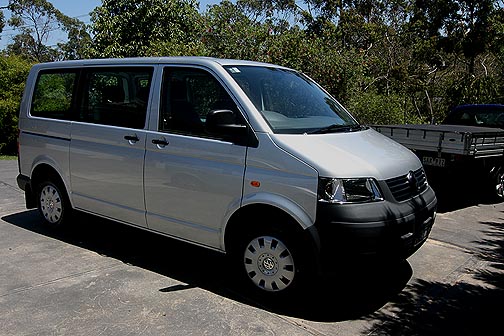
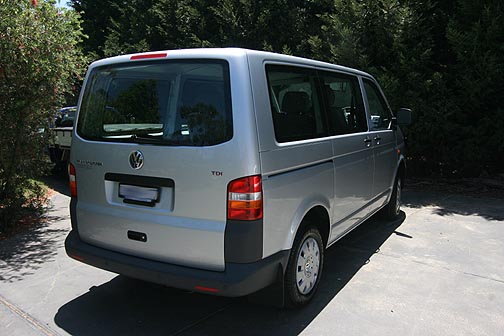
takes up no more road space than a Falcon. It is hugely roomy inside. It is
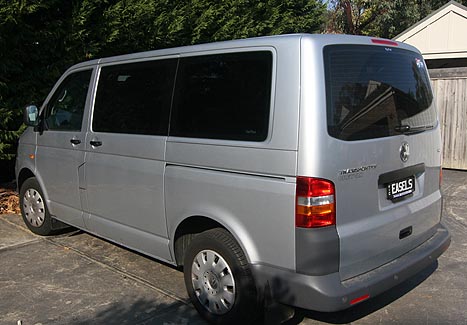
a Short Wheel Base MY08, T5 with a 128 kw 400nm diesel, 6 speed Tiptronic gearbox,
crewman option, side and curtain airbags, Dynamic Stability Control which includes
ABS and traction control. Deluxe seats, reversing sensors, trip computer fog
lights and factory alarm. I chose a metallic silver finish with full windows.
The first thing you notice
about the van is how high you are off the road and the great drivers vision.
The optional, premium seats are comfortable with height and lumbar adjustment,
plus adjustable arm rests. The trip computer is a weird red on dark red and
not as easy to see as LCD, however with Sunglasses on, the reverse applies!
It is noisier than a petrol motor, on acceleration and idle, but surprisingly
quiet when cruising. The gearbox is very sweet, shifts are very fast and smooth,
plus it also gives engine braking. You can also manually select and change gears,
but to me that is a waste, unless you want to hold a low gear going down hills.
You seem to waft along the open road. Road noise is very good, even on coarse
chip.
The steering takes a bit
more turning of the wheel than I am used to, but parking and U turns are very
easy. It does not seem to sway a lot for such a tall vehicle when cornering
with fully independent suspension. Familiarity takes some time.
This van does fly, there
is no such thing as a hill that will slow it down and it can tear away from
traffic lights, if you want to. Passing on the open road is very quick. Volkswagen
quote 0 to 100 kph in a little over 12 seconds, with a load of 500 kilograms!!
The engine is not common
rail but duse pump, which means that each cylinder has its own high-pressure
pump. There is a huge particulate filter in the exhaust to catch and burn off
any un burnt fuel, smells and particles that diesels are renowned for. No pollution
from this beast.
Late September 2010:
I owned the van for 2.5 years and grew to hate it. I never got used to the diesel
noise, the strange seating position for a tall person that ended up giving me
shoulder problems. The 1990,s electronics, paint that chipped way too easily,
an interior that scratched way too easily, a heater that was poor, headlamps
that were way below standard. A suspension that cost me $1000 to get right and
then the van broke down and took 3 weeks to get back on the road. I sold it,
now I have a Falcon 50th Anniversary Turbo Ute
and it is like making a generational leap, virtually no engine noise, a gearbox
(ZF6 Speed auto) that is undetectable on changes, the luxury of rear wheel drive,
a trip computer that is actually accurate, dash displays and controls that are
a generational difference from the VW. I always felt that European vehicles
were over rated and over priced. The VW proved it to me. VW cars must be a lot
better than their vans or are they? I doubt I will ever buy anything form Europe
again.
The
Seats
Seats are covered in a durable
feeling woolen type fabric; I opted for the (expensive) deluxe front seats,
which have height adjustment, twin armrests and lumbar support. I found that
after about 35 minutes driving in thin summer slacks, the woolen fabric felt
coarse through my trousers. I fitted a set of sheepskin covers and the comfort
factor rose considerably. You cannot adjust the angle of the base and they seem
a little hard. I love the armrests which have angle adjustment built in. I do
however find that I would like to pull the telescoping steering wheel a bit
closer than it goes, I feel I am long arm driving unless I pull the seat forward
then it is knees too close to the dashboard. On long trips the arms get very
tired. I would also like to tilt the squab a little, but there is no ability
to do so. There is no centre console, you can actually move your left leg around
without crushing it against anything, you can walk into the back seat without
getting out of the van. You can climb in through the passenger door and easily
get into the drivers seat!! I have found this to be a real bonus. Underneath
both front seats there is electrical wiring disappearing into the seat, I expect
it is for heated seats, which my van does not have, plus the side air bags.
After the first trip to Sydney and back I give the seats full marks as my bad
back gave no trouble whatsoever. At no time during the trip did I feel in physical
discomfort. My opinion of the seats rose considerably after that trip. Nov
09 - The drivers seat is really fabulous, particularly on long trips,
my back and bum have never been sore, even after driving for 14 to 15 hours
in one day, which I did recently. Jan 2010 I have had shoulder
problems which started on one of my Sydney trips it is now July 2010 and they
are just starting to get better. I visit a physio every 2 weeks and he has me
on exercises. The long arm steering position started it, but I do have certain
muscles that need to be built up more to cope. Had the steering wheel been capable
of getting closer to the seat I may have avoided the problem.
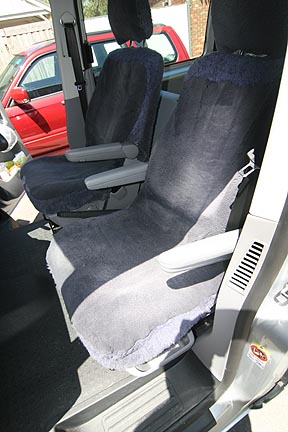
The front deluxe
seats with sheepskin seat covers, I replaced these covers with 100%
sheepskin, with airbag cutouts. |
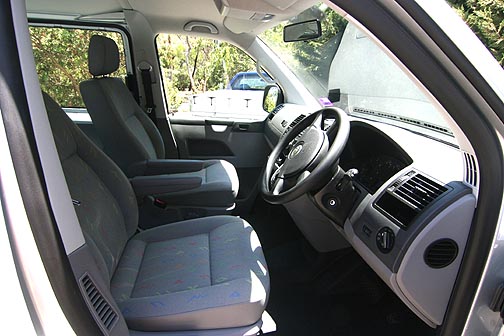
Fronts
seats before fitting of seat covers |
The back seat is huge, tons of legroom and plenty wide enough for 3 adults.
The van seats 5 and they will never be cramped. The back seat is molded for
bottoms and has the seat belts neatly attached. The rear seat is easily folded
flat then folds again up against the front seat leaving about 1.8 metres of
space in the rear. It can also be fully removed, but it is a 2-person job to
carry it and I would not want to try it without 2 sliding doors. To unlock the
entire seat from the body you simply press a catch, and it is free. On long
trips I this the best place for a power nap, as long as you are empty and have
not had to remove the seat. It is easy to climb through from the front to the
back and curl up for a 20-minute refresher. I am not sure I would want to sleep
there all night though.
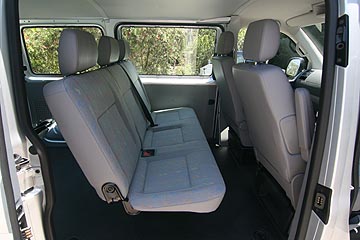
Rear
seat is very roomy |
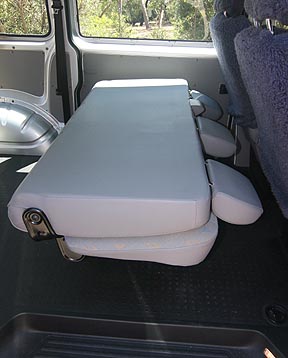
Rear
seat half folded |
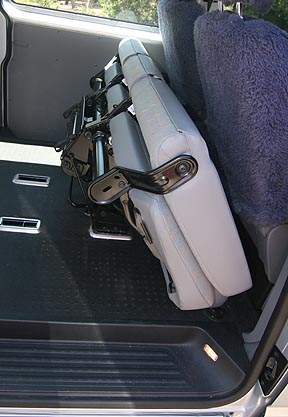
Rear
seat fully folded - van has since been professionally carpeted. |
Removing the rear seat
is very easy, as long as you have a 2 rear door van and 2 people. It weighs
30 kilograms at a guess. It would be a lot more difficult to remove with only
one rear door.
Gearbox.
The tiptronic gearbox is
a 6 speed box. The gearbox also selects the gear appropriate for the engine
speed, so that as you slow down, the box changes down. On initial acceleration
in normal mode the tachometer seems to hold around 2000 to 2500 revs as gears
1, 2 and 3 are quickly used, from then on changes depend on speed. At 60 you
are in 4th, at about 70 in 5th at about 80 in 6th. At 110 kph the motor is only
doing 2000 rpm, right on the maximum torque. Gear changes are so fast they are
not felt, particularly 1-2-3.
You can also put the gearbox
into sport mode where the engine revs out to a bit over 3000 revs on normal
gear changes. I have found I prefer not to use sport mode as it seems to hang
onto each gear for a fraction too long.
When you take off slowly
it is not so smooth, as revs build and the turbo kicks in so does the acceleration,
it is not totally linear, but smooth then a surge. Flatten the accelerator ,
a slight delay and then it is brimstone and fire, the front tyres chirp, the
traction kicks in and off you race, howling diesel and indecent acceleration
for such a van. The best way to avoid the surge is a measured prod which leaves
you at the front of the pack at the lights. If you are simply maneuvering, say
reversing, the idle of the motor takes you along at a comfortable speed, not
much accelerator required. In most cars you can push the accelerator and the
acceleration curve is linear, however with the Transporter it takes off in an
initial rush ( after a little turbo lag) and once it hits third and fourth you
and you need to give it a bit more accelerator to maintain the same rate of
acceleration. You get used to this and cease to notice it pretty quickly.
You can select the gears
manually, you pull the lever across to you and to change up you push it towards
the dashboard. It will not let you select a gear if the engine revolutions are
inappropriate, and it will also change gears for the same reason.
The
Engine
The engine is a very powerful in that maximum torque of 400 Newton metres is
at about 2000 revs. and a relatively flat profile until close to 4000 revs.
Hills mean nothing. Put it in cruise and the speed is held regardless. You are
always aware it is a diesel. It clatters away merrily, only when you back off
the accelerator or at cruising speed, does is quiet down. It is not that unpleasant
and you aware that there is more power than you really need for most situations.
It has an extensive engine management display in the dashboard and when you
lift the bonnet it appears compact and uncomplicated. I was issued dire warnings
about not changing oil myself unless I used the recommended, premium diesel
synthetic Castrol oil . It really seems to be a sweet, willing and quite potent
if a little noisy, engine.
Starting it is like any
petrol motor, you are supposed to wait until the glow plug indicator in the
instrument panel goes out, but in reality you hop in, turn the key and it fires
instantly.
Combine this sharp engine
with the crisp gearbox, plus great gearing and you have a package that really
works well. It is raw but cohesive, you know you are driving as you can feel
it all working in harmony. It grows on you, as it has character.
Front
Wheel Drive
The Transporter is Front
Wheel Drive. You would not know it under normal circumstances, but if you accelerate
going around a corner you can feel it through the steering. That is about the
only time. Having traction control and electronic diff lock helps the drive
situation enormously and unless you are really silly you should not find problems.
You should be able to drive up wet grassy slopes. I must admit I love the traction.
After owning a BA Falcon cab chassis, where you could not put the power down
on wet roads and steep slopes, it is a delight. The floor is totally flat and
there is room for the spare under the rear of the van, both thanks to the front
wheel drive.
Noise
Levels.
There is no escaping that
this is a diesel. The engine clatters into life; rattles away on idle and sound
like a demented sewing machine on acceleration. However at about 80kph it all
starts to fade away. At 110kph you cannot hear the engine, tyre noise and wind
noise are not too intrusive and the van has entered its element. It eats up
the kilometres effortlessly, the tachometer sits on 2000 rpm, and you are almost
in van paradise.
10 April 08 New
carpets fitted. The carpets were tailored to the floor, and cover front
and rear wheel arches plus the exposed metal in the rear up to the window line.
They were installed over the existing matting. Custom Covers in Mornington Vic
- Trev -0488075483 did a really great job for less than $1000. They look wonderful
and there was an immediate reduction in noise, both engine and road.
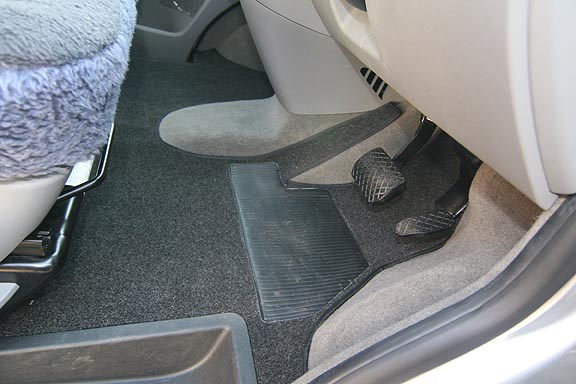
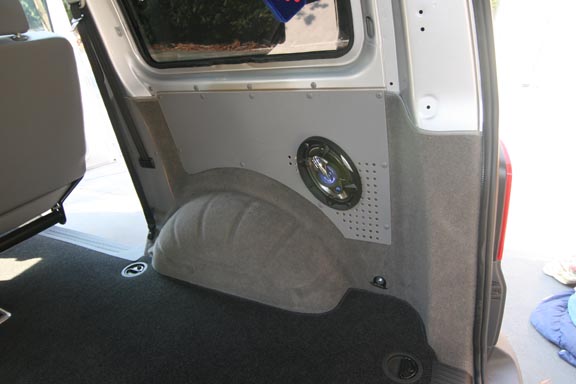
New carpet:
note how it is 2 tone. The drivers floor is complicated but Custom Covers did
a great job. The rear quarter panel is the original VW chipboard with the new
speaker.
26-4-2007
I soundproofed under the dashboard. Firstly I had to remove the plastic
lining. VW use a strange six sided screw with fins, but fortunately I had a
similar one in my tool kit and discovered there was sound insulation but it
is cut out for the clutch, in other places below the gearshift there is also
bare metal. Patchy insulation is also in other places under the dash. I attached
a bitumen soundproofing to all bare metal. This is 3mm thick and has an adhesive
back. Then I stuffed every crevice and under the dash with fibre glass insulation,
packed in tightly. Refitting the plastic panels was very difficult as the screws
did not sit or hold on the screwdriver end. I also had to use a couple of Phillips
#2 screws, which are the most common heads and sit nicely so you can guide them
into awkward spots. The van is definitely quieter, particularly in the higher
frequency noises the engine makes, not such a sewing machine now. I am very
happy. It would not have taken much for VW to get a similar result. It is not
as quiet as a Falcon, but I do not think I can do any better as the engine is
pretty noisy in itself. I counted 23 small scratches and cuts on my hands, Lots
of sharp little things under there. Now the engine is not intrusive at any cruise
speeds!!! Hooray!!!!! I do not even need to turn up the wonderful sound system
any more to drown out the noise. On my 30,000 kilometres service 7 june 2009,
the VW service people ripped the under dash insulation out claiming it was a
fire hazard, without my permission. I am not happy about that, as they should
have asked first. Fortunately the noise has not jumped so it seems the it was
the bare metal that was letting the noise through. .3-5-2008 I pulled
out all the panels on the doors and rear quarter and stuffed them with insulation.
I did this to allow the air con and heater to work more efficiently as there
is nothing between the thin MDF lining and the outside skin of the van. I did
not do the roof, as the gap appears to be very thin, say 20 mm and the insulation
I was using would have been too difficult to fit. It made another small reduction
in road noise. My housemates '06 Forester has more road noise now, than the
van.
The
Cheap Obsolete Radio - Not Ipod Compatible
The standard radio is all
appearance and very ordinary, in fact cheap, nasty and obsolete almost does
it justice. It is MP3 but only to play MP3 CD’s? Sound is dull and lifeless,
not great. It has 4 speakers, two in the dash and two in the bottom of the front
doors. In the owners manual you are told how to balance the sound between the
doors and the dash, but for the life of me, I could not. Maybe there was only
a couple of door speakers as when I replaced the radio and speakers I was only
given the nasty door speakers back. It seemed to have good reception range on
radio but I have not a clue as to how it sounded with a CD. The knobs and various
buttons worked well and it was simple to use. At night all the knobs buttons
and dials light up in red outlines. After a trip to Sydney using an Ipod and
a transmitter I immediately ordered an aftermarket, Ipod friendly, head unit
and speakers.
6
March 08- New radio or head unit fitted.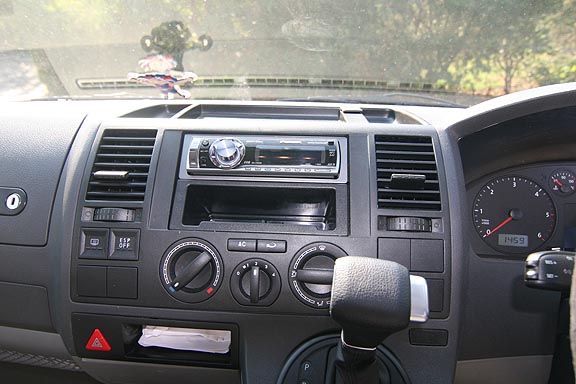
A Pioneer DEHP5950IB
Head unit and premium Clarion 6 inch 2 way speakers, in doors with separate
directional tweeters in dash, plus 4 way premium speakers in the rear. This
gave me full ipod control, eliminating the need to carry cd,s on long delivery
trips. My ipod has thousands of legal songs on it. The sound in the van was
great!!!!
The Pioneer
was an excellent
unit however it was then replaced in 19 Nov 09 by a
Clarion CZ509A. The reason was to have Bluetooth for the mobile phone.The
Clarion runs ipods and USB thumb drives. I immediately noticed an improvement
in ipod sound quality, perhaps it is because it better matches the Clarion speakers,
or perhaps it is a better unit. It is supposed to have state of the art circuitry
to interpret and play MP3 with improved sound quality. The Bluetooth is fantastic,
it automatically rings in the car as long as the phone is in your pocket, and
the radio switched on, you then just talk. Making a call is almost as easy,
you just cycle through the numbers in the radio and press dial. I am 100% happy
with the radio speaker combination I have. The Clarion has terrible AM reception!!!
Handling/Ride
It handles pretty well.
It corners with little sway. There seems to be constant movement up and down.
It follows road indentations rather than ironing them out. It does corner pretty
well for such a tall beast. The ride from new was bouncy, particularly when
empty.
August 09 I
had enough with the bouncy ride,( It to me is a Occupational Safety and Health
issue) and ordered a set of Bilstein shock absorbers to be fitted by Pedders
Suspension Frankston Branch. They certainly removed the bounce. Now it is
firm on the road, the secondary bounce when you go over bumps and dips has gone.
This cost me $1050, but why could not VW fit decent shock absorbers in the first
place? Pedders said they do a lot of Transporters, and Vito's, that are no better,
and Sprinters for that matter. So it seems to be something that the Germans
have not come to grips with. I also checked the tire pressures and according
to my gauge they were 50 psi all round, pumped up at the last service. I deflated
them to 38 psi. I will never carry a load close to 1 tonne, so rock hard tires
are not necessary. Now it rides like a car, and does not crash through bumps.
I then drove 4000km in 5 days, see box below. I would never have been able to
complete that drive in that time with the old shockers.
Doors.
I ordered a drivers side-sliding
door. The standard T5 only has one sliding door on the passenger’s side.
I use the right hand side door just about every time I take the van out or collect
something. Way easier to toss small things in behind the driver onto the rear
seat, rather than go to the rear or the passenger’s side. The two heavy
front doors open wide, you have to take care not to hit neighboring cars. It
is pretty easy to open past the detents. The rear hatch door opens easily and
high. I am 1920mm tall and it is way over my head. Suits me but there is a grab
handle for shorter people. The door locks are dead locks!!
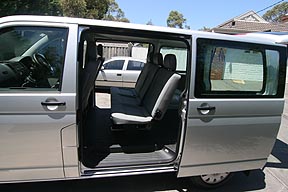 Something you cannot do with normal transporters, look through and load through
two side doors.
Something you cannot do with normal transporters, look through and load through
two side doors.
Right
Hand Rear Door.
I cannot imagine this van
without a drivers side sliding door. Trying to load easels only through the
rear and passenger side door, and to pack them so they nest properly, then tie
them down, would be a real pain. You can easily reach the drivers side tie down
point which I use every time. Volkswagen should make 2 sliding doors standard
in a vehicle that costs as much as this one does.
Central Locking and Keys
The van has central locking
from the key, but to open any other door than the drivers, you have to press
the button twice. The keys are micro chipped and if you lose them you must get
a new one from a Volkswagen dealer coded to your van, otherwise you cannot start
the car. The keys are the flick knife type, in that the blade folds into the
body and the locking buttons are on the body. You get 2 keys and I ordered a
third key for $35, but it is just a simple blade type, the sort of thing you
can take to the beach and get wet. I keep it in my wallet. If you use it to
open the van you need to put it into the ignition within 30 seconds otherwise
the optional alarm goes berserk. One press of the button opens only the drivers
door, two presses open the other doors. It actually has always annoyed me that
they all do not open with one press.
Driving
The first thing I noticed
was that I was going faster than I thought I was!! It just gets there quickly
and un fussed and just wants to keep going. I had to reassess my driving a little
and concentrate on the speeds I was doing. Here the cruise control is a godsend
and I find I am constantly driving with cruise rather than the accelerator.
Without the cruise, I still find at times I am doing more speed than I expected.
This van simply does not struggle to reach any speed, it just gets there with
out any strain, you do not have to wait for it to happen. I do enjoy driving
it as you have incredible vision. You seem to tower over everything else on
the road, except semi trailers. 4 wheel drives, no problem, you can see over
them! The windscreen and side windows are tall and give panoramic vision. I
ordered full windows, as I really do like to see everything when I drive and
hate blind spots. The brakes are excellent. It is a comfort to know that you
will have to do something incredibly stupid to get handling problems. On wet
roads, it is wonderful, no tyre spin, the wipers do a great job as does the
demisting system. The exterior mirrors are also heated, and if covered in dew,
clear within a kilometre of starting up.
Headlamps Terrible, not good enough for Australia.
A switch on the dashboard
controls the headlamps. The transporter's lights are poor on low beam, but very
ordinary on high. There is too much spread of the light and not enough penetration.
I immediately replaced the globes with Phillips blue lamps, which are supposed
to give 80% more light, well it is more like 25% but it is still better. On
high beam the lights, have a very wide spread and lack penetration, even with
the new globes. I was used to the headlamps on a BA Falcon and the VW high beam
quality is not even close to the Ford. Low beam is OK having adequate light
and a wide spread.The optional fog lamps are as good as useless as supplementary
lights, as they only seem to light the road a few metres in front of the van.
August 09
I went to Autobarn, wanting to try
to get some driving lights fitted for an upcoming delivery trip to Queensland
and they suggested I change the Phillips blue lamps for Phillips yellow ones,(in
a red packet) which have better penetration. They are supposed to go 25% further.
They cost about $40 per globe and were marginally brighter.
May 2010 I
decided to have another go at improving the headlamps. I fitted a set of
HID lamps. 55 watts, supposed to produce 3 times the light. Wow they are
bright. You can clearly see the fractured light spread from the reflectors in
the VW . I am now reasonably happy although the old bugbear of lack of penetration
is obvious but these lamps are so bright it should not be such an issue. Cost
$180 on ebay, easy to fit took me an hour. It is much more complicated than
changing the globes, as you have Ballasts and a relay, however the new wiring
was well designed. The hardest thing was finding a place to fit the ballasts.
The only thing that worries me is that they may increase the glare for oncoming
motorists, but so far I have not been flashed and I have adjusted them so they
hit the road reasonably close to the van.
July 2010
These headlamps are wonderful. I have not been flashed once by other drivers,
and when I now drive other cars, the headlamps are like candles. Reflectors
and signs are illuminated way better than with ordinary lights. Open road driving
at night is vastly improved. One of the best things I have done to the VW.
Cruise Control.
The cruise is on the end
of the indicator stalk, on the left of the steering wheel. It has 2 little toggle
switches at the end that are easy to operate with a fingertip. Press the bottom
of the toggle and the cruise is engaged at the speed you are traveling at, hold
it down and there is a smooth decrease in speed until you release it. Pressing
the top toggle increases speed smoothly when the cruise is engaged. If cruise
is not engaged, pressing it resets to the previous setting.
A switch on top, switches cruise on and it stays that way regardless of the
ignition, you do not have to turn cruise on every time you start the engine.
You use the same switch to turn it permanently off. To turn it temporarily off
you flick the switch on the top of the lever, which is not so easy. Overall
it is a very good system, perhaps the best I have used, with the exception of
temporarily turning it off, as it is a easier to press the brake pedal.
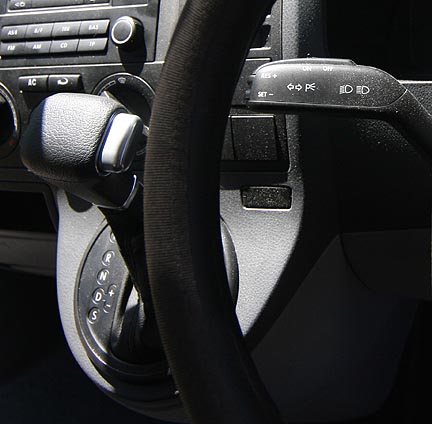
Cruise control
lever is actually very good to use. The gearshift positions are on the
wrong side of the gear shift and you cannot read the markings from the drivers
seat, the gear positions are repeated on the instrument panel but are
hard to read. You do quickly get used to it.
Air
conditioner/Heater
There is an awful lot of
volume to cool down. It is a pretty basic system of dialing in the coolest setting,
pressing the air conditioner button and dialing in one of 4 fan speeds. Using
the system on full blast makes you feel there could be bigger vents for the
air to exit. It certainly is cold enough. You cannot feel any effect on the
diesel motor when it is on. The rear seat passengers also have their own little
vents, with the ducting running through the front doors. On idle, the trip computer
shows that the air-conditioning uses 0.3 litres per hour of diesel. The vents
can be closed individually and adjusted for angle. I have tinted the windows
to try to reduce radiant heat. The Air conditioner struggles in really hot conditions,
over 40 degrees C.
The heater takes too long
to gain full efficiency. The VW throws out some heat after 5 km and about 13km
to get hot, when the temperature gauge reaches normal operating temperature
in cold weather. On a cold, say 7 degree morning it takes 20 k of driving to
start to fell warm in the van. Demisting is fast and powerful. The heater output
appears to be directly proportional to the position of the temperature gauge.
Rear
View Mirrors
The rear view mirrors are
electrically operated from the driver’s door and feature heating for winter,
which works really well. On both sides cars appear further away then they really
are. The outside of the driver’s side mirror has extra curve to expand
the vision range. They are quite large, the passenger one is orientated vertically
and the drivers horizontally.
Electric
Windows.
The windows are one touch all the way down, or up, except just after the ignition
is turned off then you can send them down as little as you require on dewy mornings
the windows are wiped clear when you lower them.
Tinted
Windows
I
had the rear windows tinted very dark, mainly so passers by could not see what
I am carrying. When driving, vision is still good. The wind down windows in
the front were also tinted , but a lot lighter. There is an added benefit that
tint reduces the heat ingress in Summer, but I have also found that the glare
from headlamps is greatly reduced through the rear window making night driving
more pleasant I am so pleased with the tinted windows that I will always fit
them to any future car or van I own.
.
Reversing
Sensors.
This is the first vehicle
I have owned with optional reversing sensors, and so far they have been worth
their weight in gold. They operate automatically in reverse. In Sydney I was
up a narrow lane delivering a big easel and had to turn around by driving into
a narrow drive and reversing out. Backing back the sensors started to scream
and I stopped. Below the window height a concrete and rock wall jutted out,
above rear window height it was about 600 mm further back. I would have backed
right into it, as it was totally hidden.
When parking these things are magic and give you great confidence.
Body
Protection.
There is great body protection front and rear with substantial plastic bumpers,
The front overhang is short and high, so no scraping the front underside on
gutters when parking nose to kerb, however there is nothing whatsoever along
the sides, and this could be a serious area of minor damage if frequenting car
parks with parallel parking. I picked up one small dent from another door despite
being super careful where I parked.
Storage
Space.
The storage space is a strange
mix, seemingly unrelated to the things you can and would use in a van. The doors
have great storage; there is a space for large bottles plus two good-sized spaces.
Above the driver is a flip down sunglasses holder that does not fit glasses
when they are in a case. The dash features several open spaces and there is
another above the windscreen in the middle. The cigarette lighter is in a handy
little pull out drawer with 2 spring loaded cup hold holders. In the middle
of the cup holders is a little drawer for coins (the ash tray). On the top of
the dash is a cavity with several partitions where you can leave things in full
view of the public. Under the glove box is a netted section; I have found it
good for papers. The glove box is not very large. There is no obvious location
to store cd’s, except the glove box and you would only put a small number
in there.
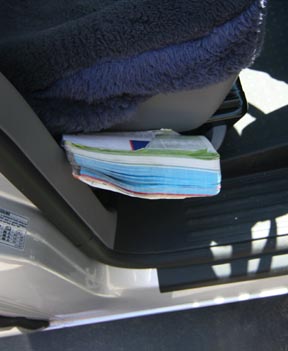
|
There
is not a better place I could find for my tatty street directory, see
how it is curling down. |
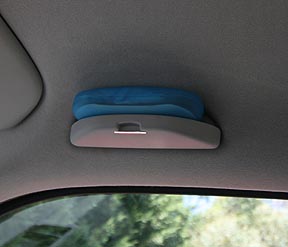
Sunglasses
holder with my sunglasses in their case. The holder is way too small,
but the case has only fallen out twice. |
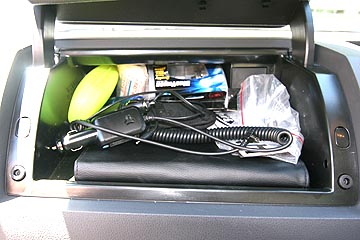
Glove
box is small. In addition to the owners manual, there is the charger for
a satnav, a glasses case with spare glasses, the original headlamp globes
in the box the Blue headlamps came in and very little room for anything
else. I have ditched the spare lamps, and the ipod now sits in there as
it is fully controlled by the new radio via a cable into the glove box. |
The interior has slippery
rubber or plastic mats throughout. If you put a box on the floor it can almost
end up anywhere as it will slide around on the flooring. In the rear there is
nowhere to store such things as tie down straps.
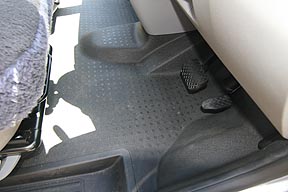 The floor covering looks as if it would be anti slip but it is actually quite
slippery,
Carpet is a lot better.
The floor covering looks as if it would be anti slip but it is actually quite
slippery,
Carpet is a lot better.
Filling
with Diesel can be a Major Problem
The filler is located behind
a hatch on the passengers side. This means there is only one way you can approach
bowsers as there is no possibility of pulling the filler nozzle across the top
of the cabin. You have to open the door, open the hatch, close the door, unscrew
the filler cap and place it in a slot. The opening to the filler is the small,
unleaded petrol size, but many diesel nozzles are large diameter and do not
fit into it!!!!!! You can avoid the big nozzles once you work out where they
are in your area, but on an interstate trip you will invariably find most service
stations have one pump with a small nozzle.
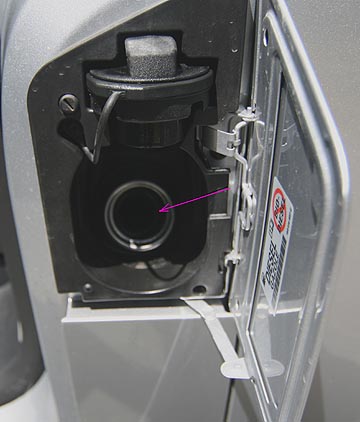
The filler opening
is too small, the pink arrow points to the restriction that prevents
insertion of the large diameter nozzles that are in most service stations.
Very Hard to photograph.
|
Diesel bowsers are dirty
places; you get it on your hands and soles of your shoes, as diesel does not
evaporate like petrol. I noticed at a truck stop all the truckies were using
gloves or rags to hold the nozzles, the only ones not using something on their
hands were a grimy, bitumen spattered, road repair crew. I have been carrying
a box of throwaway latex gloves.
After 12 months
ownership I find this no longer to be an issue, I am used to using gloves and
seem to always find the small nozzles now. In service stations I do not know,
I park and ask there always seems now to be a small nozzle on the right side
for me, somewhere.
Fuel
Economy.
The first tank of mixed running around gave me a bit over 10 litres per 100
km that dropped to high 9,s on the second. The third as about the same and then
on a run up to Sydney with a 600 kg load it was still high 9’s. On the
return I could not exactly verify the figure as I was trying (in the dark and
tired at the end of the journey) to fill the tank from a large diameter fast
fill nozzle. Diesel was spilling down the side of the van and after 60 litres
I gave up. I think I got mid 8,litres per 100 km. The lying trip computer said
7.9 so that would make it closer to 9. Trouble is the fuel gauge said full,
but I believe I could have added something like 8 more litres. I expect as the
engine is run in, the economy will improve. I neither drive for economy, nor
do I thrash it.
I at last had a chance to
check the fuel economy, a delivery trip to Portland Vic. I filled at Geelong
(had to go to 2 service stations to find a small nozzle) Then filled the day
after I got home. 8.5 litres overall consumption. I did us the ferry both ways
to get to Geelong. If you do not know the road, it is a disgrace, masquerading
as a highway, I did 100 when possible, but there are few places to pass and
I followed long crocodiles of cars several times at 90. The towns have limits
of 80,70,60,50, 40, take your pick, yes I drove during the 40 limit school times.
I had the air conditioner on most of the time. I have often thought it would
be great to live somewhere like Port Fairy, but the thought of having to drive
that road on a regular basis would totally put me off.
19 August 2008.
Van now has 10,000 km and last tankful I got 9.2 litres/100km with normal running
around. Under the same conditions my old BA ute got 12.5 l/100 but when you
consider diesel is usually 15 to 20 cents a litre dearer at the pump than petrol.
I am saving some money on fuel, maybe $400 per year, however the range of 700
to 800 km on a tank is a real bonus.
Feb. 2009
Van now has 22,000 km. The engine is possibly run in now. On the open road on
say a trip to Sydney I average 8.5 litres per 100k. Around town it is in the
low 9's say 9.2. This is measured by the number of k's traveled and the amount
of fuel I put in the tank. Diesel for the last few weeks has actually been cheaper
than petrol, HOORAY!!!! A strong headwind can add as much as 1.5 litres per
100 km to consumption. April 2010, fuel consumption has not improved at all,
the engine must be finally run in.! So that is it folks.
Steering
The steering is excellent.
On the open road it goes exactly where you want it to go. No wanders at all.
I still feel you are twirling the wheel a little too much when cornering though
and the steering wheel itself,is just too far away.
Trip
Computer.
I ordered the optional trip
computer. It has a red display on a very dark red, almost black background.
It always displays outside temperature. It resets itself every significant trip.
If you stop for say an hour in the journey it retains the information on that
journey, but if you stop overnight, it starts the next day as a new journey.
It displays all the normal things such as time elapsed, kilometers, average
fuel consumption, kilometers to empty and actual fuel usage at the time. The
trip computer,(or parts of it), is not accurate by my estimate. It showed the
average fuel consumed was up to about 1.4 litres per 100 km lower than an actual
measurement I made by the amount of diesel I could get into the tank relating
to the distance traveled between fills. I did that test several times and the
trip computer was always much more optimistic. Contrast this with the Trip Computer
on my old BA Falcon Ute, which was dead accurate. If Ford can do it, why cannot
VW. Dec 08 after 18000kms. The trip computer is erratic in that its error is
not consistent and can be anything from 0.1 litres/100k to 1.4/100k lower than
actual. The trip computer also tells you when a service is due and when the
temperature drops below 5 degrees it warns you, I expect for road ice. It is
not accurate for kilometres to empty. I put 75 litres into the tank, which meant
I had 5 left, but the trip computer was telling me I could still go 140 kilometres.
Value
for money?
This van was $53000 on the
road (which is a discount over retail when you add in the options). This was
a lot more than I had planned to spend. It took me about 6 months to come to
grips with the fact that to get what I wanted in a van I would have to spend
that sort of money. I eventually spent another $3000 plus to sort out some things
that annoyed me,(radio, carpet/soundproofing shock absorbers). That said there
is no other way you can get the safety features, folding rear seat, power levels
and an automatic gearbox in a van anywhere else. I still feel it is overpriced
and certainly some of the options should be standard like a driver’s side
sliding door, trip computer, and dynamic stability control. I do not think it
is great value for money. The problem is that if you want, what I wanted in
a van, there is no alternative. Actually I could have bought a Multivan for
the same money I ended up spending, but then again a Multivan will not carry
heavy loads.
Options
If you are happy to wait the 16 weeks for delivery there is a huge range of
expensive options you can add to a transporter. Your dealer will love you as
I am sure they have fat margins in the options.
Servicing
The service interval is
15000k’s. There is a big service due at something like 160,000k’s
The dealer strongly suggested that the oil be changed at 7,500k’s.
4 -5 -2008 First
service . As suggested the oil was changed by the dealer at 7500km.
Cost $314.65 The charge for the oil, plug and filter was $181, the rest was
for labor and GST??? A pretty expensive oil change, but they say they did check
everything out. I waited the hour it took.
Second and third
service were done on schedule and were free due to an issue prior to delivery.
22-12 2009 45,000k
service. Cost $553.55, had new wiper blades fitted all round. Sold it before
any more services.
Any
Problems?
The front end was out of
alignment from new.
December 2009
warning light on dash, to do with the sensor that controls the Particulate Filter
and it did not affect the engine performance. Dealer easily fixed this. Also
had to replace the instrument cluster as it developed a crack. New cluster took
3 weeks to arrive from Singapore. Done under warranty.
Gremlins/impending
doom One
time the interior lamps refused to come on when I opened any door. I was in
Sydney at the time. Another time the electric windows would only move if you
held the button. They are one touch normally, in that you touch them and they
go all the way down. Both problems quickly fixed themselves. In May 2010 I did
a delivery trip to Sydney via the Hume and Jarvis Bay. I stayed overnight north
of Gosford. Next day I started home and there was a terrible vibration, like
no wheel weights, a flat spotted tyre or tread separation. Straight to a tyre
service. both front tyres balanced, no difference. At another tyre service I
had all 5 wheels dynamically balanced (not one was perfect) and the spare put
on the front right, little difference. When I started home I was not game to
go over 80. The vibration was severe. Gradually it got better, the further I
drove, but was with me all the way home. In the end I drove at the speed limits,
this was after maybe 250 to 300k at reduced speeds. It was quite weird, around
left hand curves it disappeared, around right hand curves it got worse. I did
not enjoy that trip at all! At home I put the spare (formally on the RHS front)
on the left front. The vibration seemed to go but it was never there at speeds
under 70kph. After a few days of vibration free driving, I did a 50 k freeway
drive one night and suddenly it started up, as severe as ever. It did not appear
the next two drives to the same location. I drove to the airport with 3 passengers
and a third of the distance there it again started up, as bad as ever. Since
that trip, 3 weeks prior to writing this, it has gone and due to the full wheel
balance the van is smoother than ever at highway speeds. I had it booked into
Peninsula VW to see if they could determine the problem, but did not go as it
was behaving perfectly.
Thursday 8 July
2010. 57000km covered It finally broke down and left me stranded on
the side of the road. The vibration started, I had just crossed over a speed
hump, when it started vibrating, more like a wobble. It lasted 200 metres, then
there was a bang, and a grinding sound and I had no drive. The engine was running
OK. I coasted to a halt. This is only the first time in 1.2 million kilometres
of driving that I have had a car break (or crash) and strand me. Maybe I have
been lucky. In my early days I could fix things on the side of the road, then
as a mature citizen I have had new cars (Fords) and they have been reliable.
I rang VW assist and they are sent a tow truck, within 40 minutes. The driver
could not have been more helpful. Good service!!
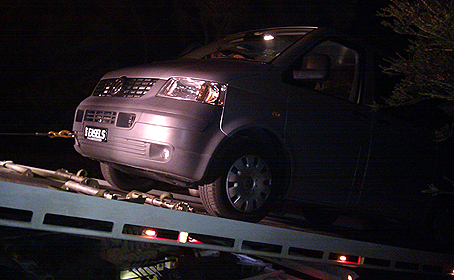 This is what every driver dreads, being winched onto a tilt tray after a breakdown.
Friday 9 July, 2010.
The van was towed to Peninsula Volkswagen. Today they were too busy too look
at it. At 10 to 4 in the afternoon I was told that a "technician"
would be able to look at it on Monday afternoon. Their loaner cars are booked
out 3 weeks in advance.
Tuesday 13 July,
Rang Peninsula VW, true to their word they looked at the van yesterday, the
left hand front drive shaft has broken. A new one is on order and it is about
1.5 hours work to replace, which they will do immediately. Must have been some
fault in the drive shaft from the beginning, but I assume they will know more
when they take it out. Fortunately my son had a spare BF Falcon cab chassis
ute, which I could borrow. Once more he said I should have bought a Transit,
as he has had no trouble from the 3 he owns.
Monday 19th July
, Did not hear from Peninsula VW all week, rang them to see if they
had a update on the parts arriving, they said they would make enquiries and
get back to me, which they did. The parts are coming from Singapore and are
due, at the latest the 28th July. They are also having a paint expert look at
my bonnet to see if bonding of the paint is an issue. The bonnet has a lot of
stone chips, where the paint seems to flake off way too easily. I just need
to be patient.
Wednesday 27th,
I was advised the parts had arrived. The van should be OK on the following afternoon.
Thursday 29th at 3pm I rang and was advised it would be ready about noon on
the 30th, as they had to replace a sensor in the engine compartment and it would
be arriving in the morning. Unfortunately I did not ask which sensor would be
affected by a broken drive shaft. Friday 27th, collected the VW. All fixed.
They had also found an engine sensor not working correctly so it was also changed.
During this time I have
been driving a well used 60.000km BF Falcon Cab Chassis, it reminded me how
good Fords actually are. The smooth delivery of power with very little noise,
a heater that works quickly, nice direct steering, great head lamps. You can
easily find a natural steering wheel position and the pedals are where you expect
them. I test drove a 50th anniversary Turbo XR6 ute and loved it so the VW was
sold. I ended up getting $36,000 but took $500 off due top the excessive stone
chipping on the bonnet. See photos below.
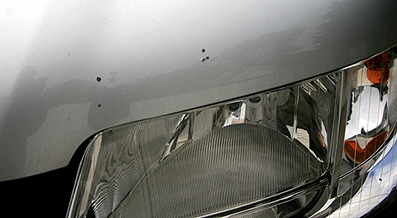
Note how pronounced
the stone chips are. This is the passengers side headlamp.
I have never
owned a car that has stone chipped so easily and badly. |
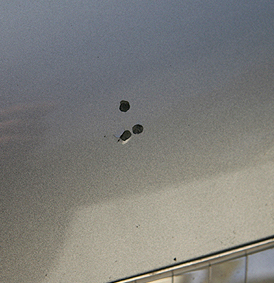
Have a close look
at the 3 chips on the Right see how they look like they are still peeling |
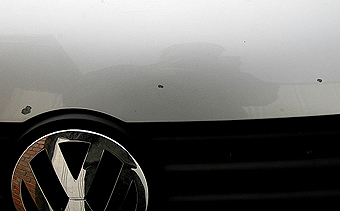 These
photos do not show all the chips on the bonnet. They were right across
the front. These
photos do not show all the chips on the bonnet. They were right across
the front.
|
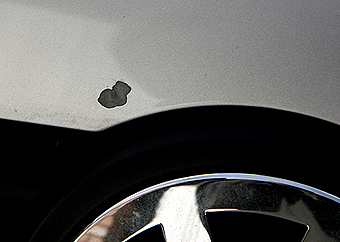
If you look closely
at this chip you can see the sharp edge as if the paint has peeled off
due to not sticking properly. |
Summary.
This is a good van, having lots of positive attributes. However it is not perfect.
I had to change the sound system, fit carpets to reduce noise and cover the
slippery floor and replace the shock absorbers. The headlamps lights are ordinary.
It is great on the open road, where it is quiet and comfortably devours kilometers,
treating all terrain as if it was flat. It has abundant power, but does not
consume excessive fuel. There is plenty of room for cargo and passengers are
well catered for in an industrial way. It feels bullet proof. No wheel spin
on wet or gravel roads, great vision, excellent maneuverability. With the superior
height and vision you feel like you are king of the roads. It is a very good
place to be when moving goods around.
After 31 months ownership
I sold it. Final straw was my shoulder (which has given no trouble since extensive
physio and exercises) played up badly after a 4 hour drive. Driving the VW long
distances is the only thing to trouble the shoulder and I put it down to the
driving position with the wheel too far away, and the upright seating position.
I only hope the new Falcon 50th anniversary Turbo Ute
I have ordered does not give the same trouble. I lost a lot of money on the
VW. It taught me that you try to avoid adding expensive options, and if it is
not there when you buy the vehicle, do not bother trying to add it, you cannot
turn a sows ear into a silk purse. The Transporter will also be my first and
last European vehicle, as I believe they are not suited to Australia. I will
never buy a VW again, the way I was treated and the time they took to fix it
after the breakdown is a disgrace.
Likes
Feels bullet proof, comfortable, tons of room , commanding driving position
and excellent all round vision, no centre console, very good at freeway speeds,
great vision, powerful, roomy, very safe, traction control/esp, safety is 4
stars, but I believe that is without the ESP and 6 airbags my van has. Great
165mm road clearance with short overhangs. Lots of character, has all I wanted
in a van. Wonderful for long distance trips. I mostly enjoy driving it.
Dislikes
Cheap radio (fixed), ordinary high beam, noisy motor, bouncy ride ( fixed with
expensive Bilstien shock absorbers), badly designed storage spaces, slippery
floor (fixed) and filling with diesel from large diameter nozzles,
which is no longer a problem as I have figured out where to find small nozzles,
Heater is too slow to get warm. Steering wheel too far away, pedals too close,
seat does not go back far enough for a tall person like me at 6 foot 3 inches.
Inaccurate, hard to read trip computer. The fact I have spent $3000 plus so
far to fix what I consider to be short comings of this van, although most people
would not bother. I hate the indicators on the left and wipers on the right,
I have never gotten used to them and every other time I drive another car I
am wiping windows to indicate, minor I know but it happens and annoys me.
It is a bit of
a love hate relationship for me!!!! After every long trip I arrive home thinking
what a great van it is, particularly since the new shock absorbers. In the end
after a long trip all I did was suffer from a sore left shoulder, which took
all the gloss off how well the van ran. I grew to hate it and after it broke
down taking 3 weeks to fix I could not get rid of it fast enough. Buy
one at your own peril!!!!! I cannot cannot recommend buying a Transporter or
anything from VW after my experience.
| June
09, I have just returned from a delivery trip to central Sydney
and just South of Newcastle. 2400 km covered. The load up was about 300
kilos and the back seat was removed as the fully assembled H Frame easels
were bulky. On the first day I traveled about 800 km and it reminded me
just how good the van is on long trips, when loaded. The drivers seat is
wonderful, it has never caused my (now 60 year old) body a problem despite
having arthritis and a bad back. All hills are flat, the van has so much
torque that hills do not slow it down but you do have to be careful of slow
moving trucks and idiots who will box you in on the outside lane as you
approach slow moving vehicles. On the return trip the worst aspects of the
van emerged. Empty, it was like riding a bucking bronco over some of the
NSW roads and the endless bouncing wears you down and tires you out. . I
got 9.1 litres per 100 on the first fill, and 7.9 on the second. No wind
and light rain. The headlights are simply not good enough for long distance
night time driving. A few weeks after arriving home from this trip I ordered
a set of Bilstien shock absorbers. They were on 2 months delivery. I regard
this as an O. S and H issue, I have noticed my fatigue levels a lot higher
on empty return trips and have put it down to the constant bouncy ride. |
| Queensland
Trip, August 09
In 5 days I drove 4000km up the Newell to Caboolture (North of Brisbane)
via Stanthorpe then home via Sydney.
The Van is fantastic for a trip like that. I did it in 4 legs each 1000km
leaving on a Monday arriving home Friday night with the Wednesday a rest
day.
Before I left I had the Bilstien shock absorbers fitted which transformed
the ride and I dropped the tire pressure from a bone crunching 50 psi
that the dealer pumped them up to at the last service to 38 psi. At no
stage during the trip was I fatigued, the van ran like a top and rode
like a car with good, slightly firm suspension. On previous shorter trips
to Sydney and back I would be fatigued, no exhausted, particularly on
the home trips as the van bounced around and crashed through the bumps.
This time on each leg, I was able to arrive feeling tired but OK. What
a difference. I also lifted the optional seats to their maximum height,
which puts the steering wheel closer and gives a bit more legroom. This
also makes it a long way to climb up and get down. My 60-year-old arthritic
body with a bad back was never troubled. What a van!!! Load on the trip
was 400 kilos (20 - H frame easels) and on the trip home some sundry items
weighing about 70 kilos. Fuel was 9.5 litres per 100km on the way up with
head winds, then 7.5 per 100 from Brisbane to Sydney and 8.5 from Sydney
to Melbourne. This van is now a very good interstate cruiser, I only wish
VW had installed decent shock absorbers in the first place which would
have saved me $1050, that said my safety and health is worth every bit
of the $1050. If I do that trip again, I will get driving lights fitted.
For outback night time driving the headlight are nowhere near good enough.
I note that the new model has dual headlamps, so VW has seen the problem.
|
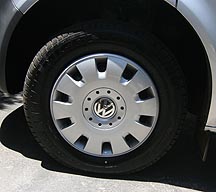
I could not justify the
price of alloy wheels but these hubcaps were quite reasonable and I like the
way they set the wheels off. I have since noticed on other Transporters fitted
with the expensive optional 17inch Alloys, that they stick out past the tyres
and often have damage from gutters. I am now glad I did not order them. Another
example of where VW could do better. The Hubcaps also suffer from gutter damage,
2 of mine are now scarred.
The
Opposition
MB
Vito - I test drove a manual Vito about 2006 and could not get out
of it fast enough. It was a miserable windy day and I got lost in the manual
gears. It was a basic van, very noisy. Before ordering the VW, I went to the
local MB dealership to have another look. The salesman told me to go away and
he would ring me to arrange a test drive! (I was in my working clothes, looking
like I was financially challenged) Naturally he forgot. I went back a week later,
before I had ordered the VW. He made all sorts of excuses and at least opened
up several doors of the stock they had on display so I could get into them,
and said he may be able to put trade plates on one for a short trip, another
time! The Vito Crewvan back seat did not fold ( I believe it now folds) and
the spare tyre is screwed to the inside rear wall where I would want a window.
The motors had less power except the Model 120 which would blow my budget and
is long wheel base anyway. They also did not have trip computers, side and curtain
airbags and things like electric mirrors and cruise were optional. With the
useless salesman and lack of the features I wanted, Vito was crossed off the
list. The fact that Vito has a 3 pointed star means nothing to me. I have since
spoken to a number of Vito owners and drivers and they are not only unreliable
but are expensive to repair.
Not sure about the new
VW as I have not driven it but it does seem they have rectified the headlamps.
Road
test on 2008 VW Multivan Sport
Road
test on a very early T5 in the UK
Next
Car Road test
Owners
reports from the UK- far from glowing
Road
test by Joe Kenwright
Easels
Galore Index Falcon
50th Anniversary Turbo Ute MY11Subaru
Liberty
My email is jeff@easelsgalore.com.au
if you want to drop a line or ask questions.
Hi Jeff, sorry to impose upon you but I have just read your story on your t5
and decided to contact you out of desperation, I have owned a transporter for
18 months and its driving me nuts,I have two vibrations one under the bonnet
which I have used a tube of silastic and a packet of cable ties on and reduced
the noise about 50%,but the other noise which is under the dash on the passenger
side I,m having no luck with.I have used your idea and packed sound deadening
insulation into every available space,but havent cured the problem.I have been
to burwin vw but they refuse to admit to a problem,even though there are several
forums out there were other owners have the problem.once again I am sorry to
impose ,but if you have any ideas I would greatly appreciate your help.
p.s. I have just listed it on carsales,but if your have any ideas I will withdraw
it,besides the vibes it a great vehical
Brian Neal
nealmon@bigpond.com